Defeat is crushing. But how do kid’s sports feel when the loss happens on the sidelines?
I saw this happen last weekend. A gaggle of parents capture everyone’s attention. Punches are thrown. Cell phones come out to show video evidence. Threats are shouted. Whistles blow.
And 30 girls who spent their whole Saturday in the cold and rain saw their efforts wasted.
Officials disqualified both teams.
Was this a one-off? By no means 🍿
Social Contagion
It’s the next morning at my daughter’s game. A parent from the other team starts shouting at the refs about fouls not being called.
Their coach warns the parents to let it be. They were up 2-0 with less than a minute in the game and seeded first in the bracket.
I had even been polite enough earlier to move my vehicle at this guy’s request to swap parking spots with his wife. And there was nothing left to pay forward.
I guess he used his super duty truck to haul excess baggage 🥁
Thankfully, the refs ended the game at the next play.
That led me to think: Is there still a place for kind acts in kids sports?
Why did I see it?
We think there can be only one winner in sports. But people on both teams can be recognized for high performance. And stretching for high performance is the life lesson they take off the field into the rest of their lives.
Everyone wins when they get better playing against themselves. No participation trophies needed.
But the focus on the sidelines is on winning overall.
There’s limited opportunities to move up and make the big money or get scholarships. That pushes stakes higher.
Maybe higher than they need to be.
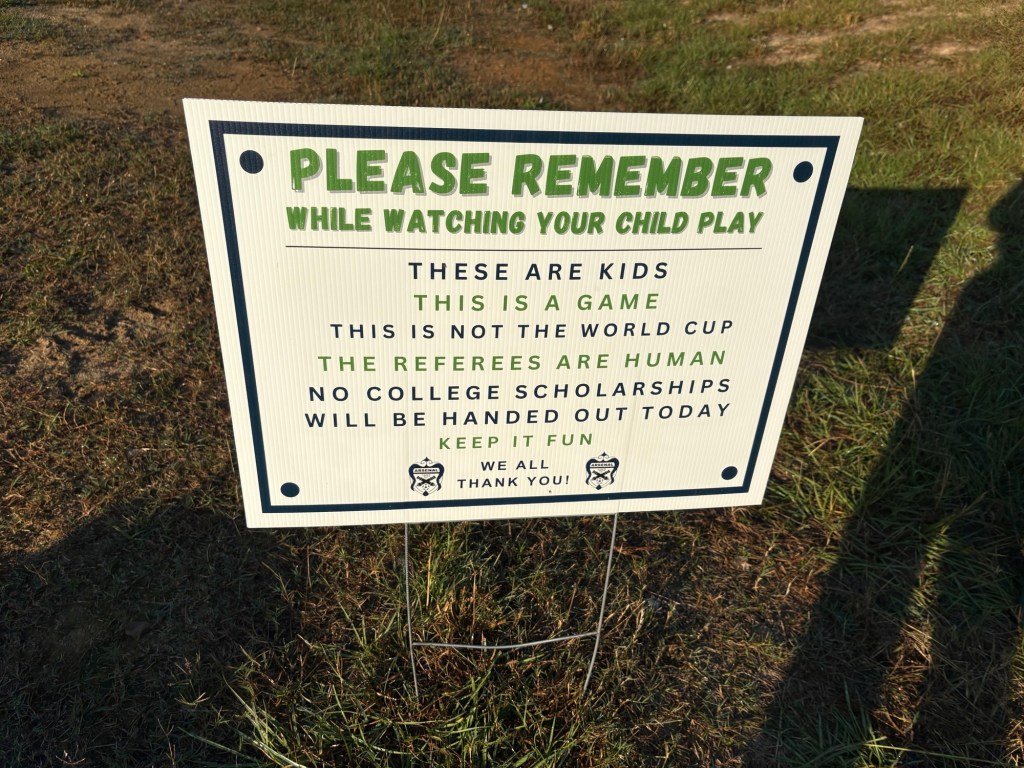
Those refs’ calls violate the perception of fairness that those parents’ kids should have outsized opportunities. And when you violate perceptions of fairness, worlds fall apart.
[Y]ou covet something and cannot obtain it; so you engage in disputes and conflicts. You do not have, because you do not ask. You ask and do not receive, because you ask wrongly, in order to spend what you get on your pleasures.
– James 4:2-3, NRSV
Fairness violated
What do I mean by that?
Let’s go back 15 years to an empty lot in Old Las Vegas. I was spooning out meals at a Catholic Worker soup line on a cold winter morning. The meals meant as much to the homeless there as victory meant to the parents at the game.
And in the process of meeting those needs, a homeless lady cut in front of someone else.
He was infuriated. He still got his soup, but his soul simmered with outrage for five minutes, processing it with a string of indignant profanities. And then he launched his bowl at her.
The bowl that held his daily nourishment he wasted on settling a score.
It doesn’t matter if it’s on the soup line or the sideline. Or if degrees of scholarships or sustenance. We want things to be fair.
Or at least advantageous to our desires…
Does it have to be this way?
Maybe it’s because we don’t want our kids to have to punch a clock like we do to support their kids. That if we clear the way for enough opportunities they won’t fall prey to the self-loathing we wrestle with.
But those high-performing, high-paying jobs they get access to via scholarships are only fulfilling if they let them be. Otherwise, it becomes a straightjacket from which they fight to escape.
Instead, we as parents can assess the situation, realize what we can do with it, then act to make the best out of it that we can. It may not earn the visible scholarships and playing opportunities, but our kids seeing our effort and imitating us is the more important outcome.
How much better people will our kids be with these values?
Self-mastery
We can always do better than our past selves. Especially with the intentional practice of pushing our own boundaries. Focusing on doing something really well and then building on complimentary skills helps at any point in life.
Teamwork
When there are things you fail at on your own, figure out where you need help and find the right people to help you. Whether it’s an open teammate down the field or a partner with a skill you’re weak in, you find and capitalize on more opportunities together.
Decision making
Problems will come rushing at your kids like they do with you. And there’s usually more than one way to handle the situation. They can kick the ball away instinctively and not be immediately responsible for turning it over. Or they can look for better opportunities that put the ball in a better spot for their team to progress.
Strategic thinking
First order thinking is going to the ball. But it takes advanced skills to push another player into a position where they’re more likely to make a mistake.
Physical fitness
This complements self-mastery, but has its own benefits. You feel better overall and have more energy to take on problems in other areas of your life.
Will to win
Even when you’re down, it’s not the end. It may take a couple minutes to shake it off and move on. And that’s exactly what we want our kids to do. Play hard until the whistle and know they gave it their all.

Practice over perception
I’ll admit, I cheered for the guy to keep going. A default win would be good for morale.
But even more I wanted my kid to beat his on the field.
More than any perception of fairness, my daughter needed to know she could do things for herself. She needed the opportunity to make decisions on her own.
And she shut down the offense several times that weekend using her own judgement.
It was a good use of a cold, rainy weekend.
Affiliate Corner
Stories of striving go beyond the playing field. And storytime with your kids needs more examples of winning on merit. Get The Tuttle Twins and The Medals of Merit today on why merit and drive are important for your developing athletes.
Get more content on raising your kids with values directly in your inbox. Subscribe to Liberty Begins at Home today!
Read more lessons to pass to your kids before you go:
 Liberty Begins At Home
Leave a comment