What’s one thing you know now that would have saved your younger self a lot of pain?
What’s the harm in chasing perfection?
After all, a lot of good came from demanding more. Civilization advances on the idea something can be better.
But I’m not talking about putting high expectations around serving the needs of others.
I’m talking about making perfection the end goal. And, in the process, becoming a perfectionist.
I wasted decades of my life on this.
Perfect pitfalls
Because being a perfectionist is lonely.
It starts out harmless enough. Doing things the “right way” the first time saves time, money, and embarrassment.
People look at you less suspiciously when you have a reputation for success. Who doesn’t want the esteem of their colleagues?
But keep leaning into perfectionism and you start to judge everything by an impossible standard.
In the pit
At a certain point, you stop looking outside and get trapped in your head.
It’s safer up there. Nothing can go wrong if you don’t try it. And in that constant looking for the safe action where you can be right, you miss out on other opportunities.
Other opportunities that could have made stronger relationships, paid better, or made you more accessible instead of hiding behind a veil of exclusivity.
When you don’t want to mess things up, you don’t initiate action.
People don’t respect others who wait for things to happen. They respect action takers.
Throw me a rope
But finding yourself trapped in perfectionism isn’t the end of the world.
You just have to learn to take more shots on goal. Not trying harder; trying more.
In doing that, you realize you have more capacity to do things than you thought. Effort is less of a finite resource and more of a muscle. A muscle that grows as you work on it.
And as it grows, you can dial in your process to do the right thing more frequently to deliver more value in meeting others’ needs.
But since you’re coming off of perfectionism like I did, you’ll need some tools to get there.
Living between extremes
First, let’s work on expanding possibilities.
Part of the problem moving from perfectionism to action is being quick to declare any new situation as impossible.
I get it. You maintain your perfection so long as you don’t change your course. All you have to do is ignore reality.
When you surrender control of a situation’s outcome, you think you’re opening yourself up to the absolute unknown. And in a world of contradictions, you’ll never know which path is safe to take.
But here’s the thing: contradictions don’t exist.
Most people set both sides of a contradiction at odds with each other and try to compromise in the middle. Except there’s 3-6 ways to make a demonstrable improvement for both sides
Now, 3-6 ways may not sound like much. It’s not supposed to. It’s supposed to save you from banging your head against a wall trying to turn the sunk cost of the vision you won’t let go of into reality.
3-6 is much easier than thousands of possibilities.
“Good enough” can be both
The next lesson comes from Notre Dame professor and former McKinsey partner Dr. Viva Bartkus. While her book “Getting it Right” sounds like a case for perfectionism, she’s actually advocating for getting to a decision faster.
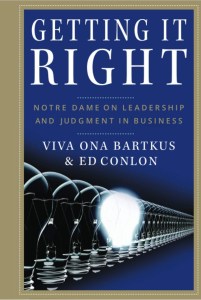
Because as long as you delay a decision, you don’t change the record on how many times you were right.
But it’s not about being right. It’s about making progress.
When “good enough” is both good and enough, it gives you permission to move forward. A little more confidently. A little less risk involved.
“Good enough” doesn’t mean that you’ll accept the outcome whether it’s good or bad. It’s just enough of a starting point to get moving, see what works, and change later.
Because sometimes the opportunities you miss get you fired faster than being right in a small sandbox that doesn’t pay the bills.
Take yourself less seriously
Lastly, take a look at yourself.
Perfectionism comes with looking down your nose at failure…then being completely embarrassed when it befalls you.
But when it did befall you, was it the end of the world? Probably not. Like most of us, you had a chance to dust yourself off and try again. Maybe even a few more times before you got it right.

What would it be like if instead you took it in stride and got better next time?
If all you’re worried about is getting something right, then it narrows your focus. But if you’re growing, both your ability to solve and perceive problems, then eventually you outgrow the problem.
Start sooner
So not all hope is lost if you start out as a perfectionist like I did. And while you never really lose it, it’s worth trying to get better.
Having standards still helps you do better than people who fly by the seat of their pants. And you don’t have to give up your standards to take action. Especially when you have the right tools to take smart action.
You can still demand more of yourself. Without wasting decades trying to make it all perfect.
Affiliate Corner
Tom Woods School of Life members like me are helping each other take action on the perfectionism that holds us back. Sign up today to start working on yours with us.
Leave me a comment below on what you want to hear more about and subscribe to get the next post delivered directly to your inbox.
Save yourself some trouble. Steal more of my experiences with these related posts.


Leave a Reply